


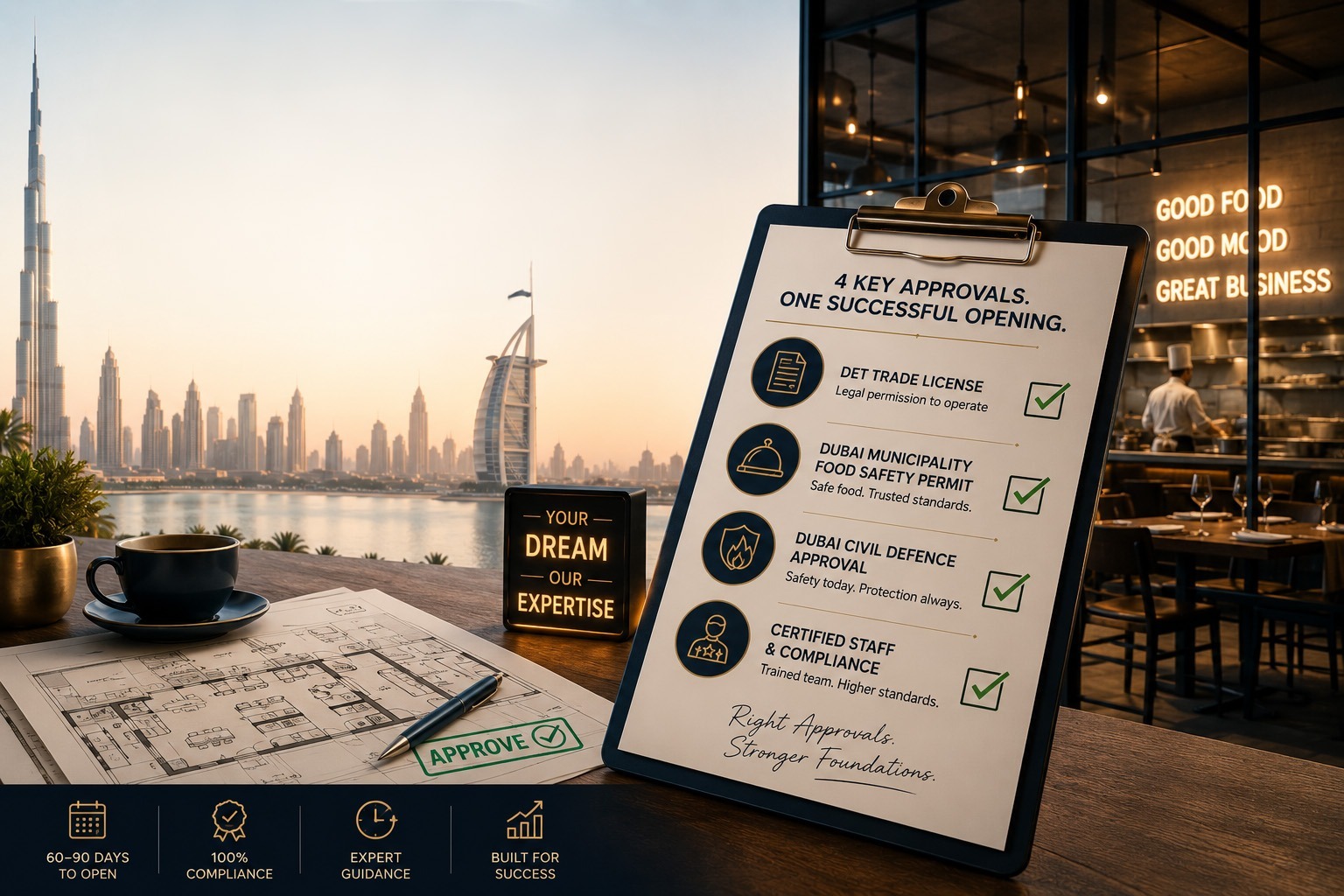
How to Open a Restaurant or Café in Dubai: Licenses & Approvals (2026 Guide)
Great food doesn't open restaurants in Dubai. Approvals do.
Every year, promising F&B concepts stall — not because the menu was wrong, but because the paperwork was. A lease signed for a unit that wasn't zoned for food. A kitchen built before the layout was approved. A launch date pushed back because one certificate was missing.
Here's the full approval map, so none of that happens to you.
Quick Answer
Who Approves What? The 4 Core Authorities
Opening a restaurant in Dubai isn't one license. It's one license plus a chain of approvals — and each authority checks something different.
1. Dubai Department of Economy and Tourism (DET)
Issues your trade license. This is your legal permission to exist as a business. Your license must carry the correct F&B activity — a café, cafeteria, and full-service restaurant are different activities with different requirements. Applications run through the Invest in Dubai portal.
2. Dubai Municipality — Food Safety Department
The authority that decides whether you can actually serve food. It approves your kitchen layout before fit-out, enforces the Dubai Food Code, and issues your food safety permit after a physical inspection. Inspections continue after opening — and they're unannounced.
3. Dubai Civil Defence
No commercial kitchen opens without fire safety clearance. That covers your kitchen suppression system, fire alarms, and emergency exits. Gas-cooking kitchens need an additional approval for the gas system itself.
4. The fit-out authority for your location
Physical construction work needs its own permit before anything is built. Depending on where your unit sits, this comes from Dubai Municipality, DDA, or Trakhees. This is why "where is your unit?" is one of the first questions any good consultant asks.
Mainland or Free Zone: Which License Do You Actually Need?
Short version: if the general public walks in and eats, you need a mainland license from DET.
Free zone licenses can work for cloud kitchens, catering operations, or outlets serving customers inside that free zone — but a free zone company can't legally serve walk-in customers across Dubai without additional structures. Choosing a free zone to save on setup costs is one of the most common (and most expensive) mistakes first-time restaurateurs make.
Step-by-Step: How to Open a Restaurant in Dubai
Step 1 — Lock your concept and business activity.
Restaurant, café, or cafeteria? Each maps to a different licensed activity with different kitchen and space requirements. Get this wrong and you'll be amending your license later.
Step 2 — Reserve your trade name and get initial approval.
Your name must comply with UAE naming rules. DET's initial approval is your green light to move forward — not your permission to operate.
Step 3 — Secure your premises (carefully) and register Ejari.
Before you sign anything, confirm the unit is zoned for your specific food activity. A unit cleared for a cafeteria isn't automatically cleared for a full-service restaurant. Once confirmed, sign the tenancy contract and register it with Ejari.
Step 4 — Submit your kitchen layout to Dubai Municipality.
Drawings go in before construction. The Municipality checks food-flow logic, ventilation, drainage, grease trap, and storage — all against the Dubai Food Code.
Step 5 — Fit out and clear Civil Defence.
Build to the approved layout. Civil Defence signs off on fire systems before the Municipality does its final walkthrough.
Step 6 — Get your people compliant.
Every food handler needs a valid occupational health card. Every establishment must designate a certified Person in Charge (PIC) — a Dubai Municipality requirement under the Food Code — trained to own food safety on site. An active pest control contract with a licensed provider is also mandatory.
Step 7 — Pass the final inspection and open.
Dubai Municipality inspects the finished premises. Pass, and your food safety permit is issued. Now you can open the doors.
What Does It Cost to Open a Restaurant in Dubai?
The trade license itself typically falls in the range of AED 10,000–30,000, depending on structure and activity. Across all departments, government fees alone usually total around AED 15,000–25,000 — the rest of your budget is fit-out, equipment, visas, and rent.
Most compact-to-mid-sized concepts land somewhere between AED 120,000 and AED 350,000 all-in, while premium locations and larger builds go well beyond that.
Government Fees by Department (Indicative Ranges)
Exact fees are generated per application inside the Invest in Dubai and Dubai Municipality portals, based on your activity, structure, and premises. Treat the ranges above as planning figures, not quotes.
And the checks don't end at approval — Dubai Municipality inspections continue after opening, unannounced, with your food safety records tracked on the FoodWatch platform. Under Federal Law No. 10 of 2015 on Food Safety, violations carry serious penalties — misleading food labelling alone attracts fines of AED 10,000–100,000. Serving food without a valid Municipality permit invites five-figure fines and possible closure. Compliance is cheaper.
How Long Does It Take?
For a straightforward concept with a compliant unit, 60–90 days from application to opening is a realistic window. Complex fit-outs, gas systems, or zoning complications stretch that timeline — usually because a step was done out of order.
The single biggest time-saver? Running approvals in parallel instead of one after another. That's exactly what an experienced setup partner does.
Permits Some Concepts Also Need
- Alcohol service — only possible through hotels and designated licensed venues, with approvals involving the tourism authority and Dubai Police. Standalone mainland restaurants can't serve alcohol independently.
- Outdoor seating — separate permit required for any seating beyond your leased premises.
- Entertainment — live music or DJs need their own NOC.
- Delivery platforms — onboarding to delivery apps requires your active trade license and food permit first.
The Mistakes That Stall Openings
- Signing the lease before checking zoning. The most expensive mistake on this list.
- Choosing the wrong business activity. Your license must match what you actually do.
- Building the kitchen before layout approval. Rework costs more than waiting.
- Treating staff certification as a last-minute task. No PIC, no permit.
- Going free zone for a dine-in concept. Cheaper on paper, limiting in reality.
Frequently Asked Questions
What licenses do I need to open a restaurant in Dubai?
A trade license from DET with the correct F&B activity, a food safety permit from Dubai Municipality, fire safety clearance from Dubai Civil Defence, and a fit-out permit for construction. Staff must hold occupational health cards, and the outlet must have a certified Person in Charge.
How much does a restaurant license cost in Dubai?
The trade license typically runs AED 10,000–30,000, and total government fees across all departments usually fall around AED 15,000–25,000. Full setup for a small-to-mid concept lands between AED 120,000 and AED 350,000 once fit-out and equipment are included.
Can I open a café in a Dubai free zone?
Only if your customers are within that free zone, or if you're running a cloud kitchen or catering model. Serving the general public across Dubai requires a mainland license.
How long does it take to open a restaurant in Dubai?
Around 60 – 90 days for a straightforward concept — longer if the fit-out is complex or approvals are handled one at a time instead of in parallel.
Do I need special training for my staff?
Yes. All food handlers need valid occupational health cards, and every food establishment must designate a trained, certified Person in Charge (PIC) under Dubai Municipality's Food Code.
Can my restaurant serve alcohol?
Only through hotels and designated licensed venues. Standalone mainland restaurants cannot hold an independent alcohol license.
Open Your Doors the Right Way — the First Time
Since 2010, Consult Kumar has helped founders turn F&B ideas into licensed, inspection-ready realities — handling the DET license, Municipality approvals, Civil Defence clearance, PRO services, staff compliance, and everything in between, in parallel, so your opening date stays your opening date.
Planning a restaurant or café in Dubai? Talk to ConsultKumar before you sign the lease. 📩 DM us or visit consultkumar.com
