


Accounting and Bookkeeping Requirements for UAE Companies in 2026
Quick Read
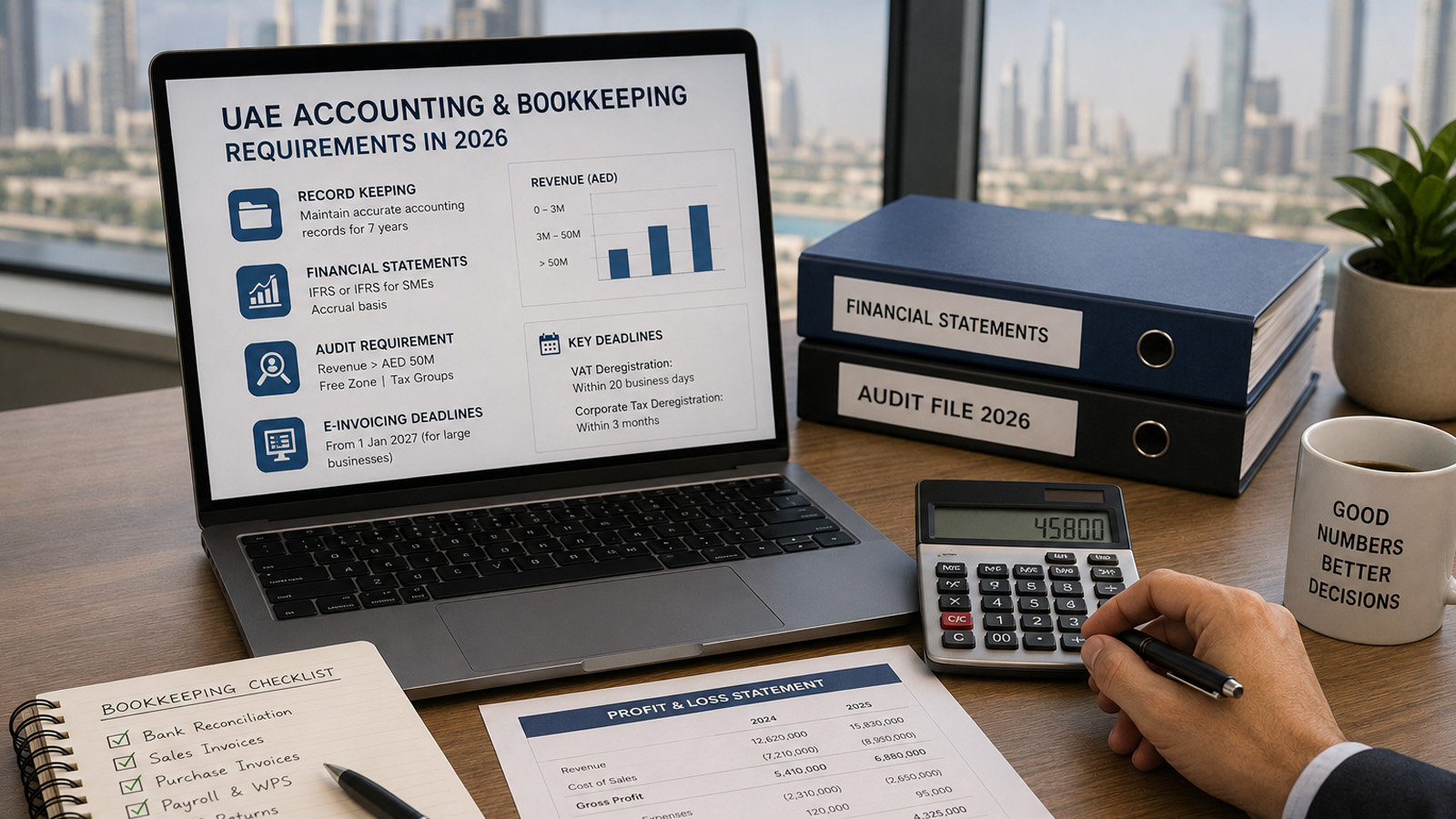
Every company in the UAE must keepaccounting records, whether or not it pays tax. Under the Corporate Tax Law,records must be retained for seven years from the end of the relevanttax period. Financial statements must follow IFRS, or IFRS for SMEswhere revenue does not exceed AED 50 million. Audited statements aremandatory above AED 50 million, for all Qualifying Free Zone Persons,and for all Tax Groups.
Two dated changes make 2026 different from2025:
- Small Business Relief closes. The AED 3 million revenue relief is available only for tax periods ending on or before 31 December 2026. Businesses that have reported nil taxable income since 2023 will file a full corporate tax return for the first time in the period after that date.
- E-invoicing becomes real. The voluntary pilot opened on 1 July 2026. Businesses with revenue of AED 50 million or more must appoint an Accredited Service Provider by 30 October 2026 and go live on 1 January 2027. Everyone else in scope follows on 1 July 2027.
If your books are currently a spreadsheet and a folder of PDFs, 2026 is the year that stops being sufficient.
What are the accounting and bookkeeping requirements for UAE companies in 2026?
A UAE company must maintain accounting records and commercial books that support its financial statements, prepare those statements under an accounting standard accepted in the UAE, retain the underlying records for seven years, and obtain an audit where its revenue, group status or free zone status requires one. The obligation applies from incorporation, not from first profit.
That single obligation is written into four separate places in UAE law, which is why so many companies discover only half of it.
The four sources of your bookkeeping obligations
The federal baseline is not optional and does not scale down with company size. A single-shareholder free zone company with one client has the same record-keeping duty as a mainland trading company with fifty staff. What scales with size is which standard you report under and whether you need an auditor.
Which accounting standard must your company use?
Ministerial Decision No. 114 of 2023 recognises only two accounting standards for corporate tax purposes: full IFRS and IFRS for SMEs. There is no third option, and informal management accounts are not a defensible starting point for a tax computation.
Two points that catch companies out. First, IFRS for SMEs is an election, not a default — if the revenue condition is not met, full IFRS applies automatically. Second, the cash basis is available below AED 3 million but must be applied consistently; a taxable person may also apply to the Federal Tax Authority to use the cash basis in other circumstances.
The threshold is tested per tax period. A company that crosses AED 50 million mid-year should not be discovering that at year-end close.
Does your company need audited financial statements in 2026?
Ministerial Decision No. 84 of 2025 governs this for tax periods commencing on or after 1 January 2025. It replaced Ministerial Decision No. 82 of 2023, which continues to apply to earlier periods.
The Tax Group change is the one to flag. Under the previous decision, a Tax Group needed audited statements only above AED 50 million consolidated revenue. That threshold has been removed. Every Tax Group now prepares audited special purpose financial statements.
For a Qualifying Free Zone Person, the audit is not a formality — audited financial statements are a condition of claiming the 0% rate on qualifying income. A missing audit does not produce a fine so much as it produces a lost tax position.
Free zone authorities also set their own filing conditions independently of the tax law. Confirm the audit and submission deadline with your own registrar rather than assuming the federal position covers it.
How long must UAE companies keep accounting records?
Seven years from the end of the relevant tax period, under Article 54 of Federal Decree-Law No. 47 of 2022. A company with a tax period ending 31 December 2026 must be able to produce its supporting records until the end of 2033.
"Records" means more than the trial balance. It means the documents that would let an FTA reviewer rebuild your numbers: sales and purchase invoices, contracts, bank statements, payroll records, fixed asset registers, stock counts, inter-company agreements, and the working papers behind any adjustment made between accounting profit and taxable income. Under the electronic invoicing framework, electronic records must be stored within the UAE.
Retention obligations under the Commercial Companies Law and the VAT legislation run in parallel and are not replaced by the seven-year corporate tax rule. Where periods differ, the longest applicable period governs in practice.
What changes in 2026: two dates that matter
Small Business Relief closes after 31 December 2026
Small Business Relief, introduced underMinisterial Decision No. 73 of 2023 and Cabinet Decision No. 49 of 2023, lets aUAE resident taxable person with revenue not exceeding AED 3 millionelect to be treated as having no taxable income for the period. It is availablefor tax periods starting on or after 1 June 2023 and ending on or before 31December 2026.
What this means in practice:
- Therelief must be elected in the corporate tax return on EmaraTax, for eachperiod separately. It is not automatic and there is no advance application
- It is not available to Qualifying Free Zone Persons or to members of a multinational enterprise group with consolidated group revenue above AED 3.15 billion.
- Exceeding AED 3 million in any period removes eligibility for all subsequent periods within the scheme, permanently.
- Registration, return filing and seven-year record retention all continue to apply. Electing the relief reduces tax, not compliance.
- Tax losses arising in a relief period are treated as utilised and cannot be carried forward.
For the tax period after 31 December 2026,an electing business moves into the standard framework: 0% on taxable income upto AED 375,000 and 9% above it, calculated from IFRS-compliant financialstatements. A business whose bookkeeping has been adequate only for a nilreturn will find that gap exposed at its first real computation. Three years ofclean, IFRS-aligned comparatives are worth more than three weeks of remediationin the filing window.
E-invoicing moves from voluntary to mandatory
The Electronic Invoicing System was established by Ministerial Decision No. 243 of 2025, with the phased implementation timetable in Ministerial Decision No. 244 of 2025. The model is Peppol-based: structured XML exchanged through an Accredited Service Provider, not a PDF emailed to a customer.
The ASP appointment deadline for largebusinesses was extended from 31 July 2026 to 30 October 2026; the 1 January2027 go-live date was not moved. Scope covers business-to-business andbusiness-to-government transactions, with limited exclusions; business-to-consumertransactions are outside the mandate until further notice.
Cabinet Decision No. 106 of 2025 sets theadministrative penalties that apply once a business is mandatorily in scope,including a monthly penalty for failing to implement the system or appoint anASP within the required timeline, a per-document penalty for invoices andcredit notes not issued or transmitted on time, and a daily penalty for certainnotification failures. Businesses adopting voluntarily before being mandatedare not exposed to these penalties.
The practical consequence is upstream oftax. E-invoicing requires master data that is clean at the transaction level —accurate trade licence details, tax registration numbers, customer records, anda chart of accounts that maps to the required fields. Companies that have beenreconciling loosely at month-end cannot exchange structured invoices in realtime. The bookkeeping work has to happen first.
What "adequate records" actually means in practice
The gap between a company that passes a taxreview and one that does not is rarely the software. It is these habits:
- Separate the company from the shareholder. Personal expenses run through the company account are the single most common reason a computation cannot be defended.
- Reconcile monthly, not annually. Bank, receivables, payables, and VAT control accounts. A twelve-month reconciliation done in one sitting produces adjustments nobody can explain a year later.
- Document the adjustments, not just the result. The working paper that explains why an expense was disallowed or a provision reversed is the record an auditor asks for.
- Keep related-party transactions in writing. Management fees, shareholder loans and intra-group charges need an agreement and a rationale, not just a journal entry.
- Match the accounting period to the tax period. Financial year, licence year and tax period should align before the first return, not after.
Your compliance calendar
Frequently Asked Questions
Is bookkeeping mandatory for all companies in the UAE?
Yes. Every taxable person must keep records and documents supporting the information in a tax return for seven years after the end of the relevant tax period, under Article 54 of Federal Decree-Law No. 47 of 2022. The obligation applies from incorporation and does not depend on profitability, revenue level, or whether tax is payable.
Do free zone companies need to maintain accounting records?
Yes. Free zone entities are within the corporate tax framework and carry the same seven-year record-keeping obligation. A Qualifying Free Zone Person additionally requires audited financial statements regardless of revenue, because the audit is a condition of claiming the 0% rate on qualifying income.
Which accounting standard applies to a small UAE company?
A taxable person with revenue not exceeding AED 50 million may elect IFRS forSMEs under Ministerial Decision No. 114 of 2023. Above that threshold, fullIFRS applies. IFRS for SMEs is an election, not a default — where the revenuecondition is not satisfied, full IFRS applies automatically.
Can a UAE company use cash-basis accounting?
Yes,where revenue in the tax period does not exceed AED 3 million, underMinisterial Decision No. 114 of 2023. A taxable person may also apply to theFederal Tax Authority to use the cash basis in other circumstances. Above AED 3million, accrual accounting applies.
Does a dormant company still need to keep books?
Yes. The record-keeping obligation is nottied to trading activity or profit. A registered company with no revenue muststill maintain records, file its corporate tax return within nine months ofperiod end, and retain supporting documents for seven years.
Howlong do I need to keep invoices and receipts in the UAE?
Seven years from the end of the relevanttax period, for corporate tax purposes. Retention requirements under theCommercial Companies Law and VAT legislation run in parallel. Where theapplicable periods differ, keep records for the longest period that applies toyour entity.
Doeselecting Small Business Relief remove the bookkeeping obligation?
No.A business electing Small Business Relief must still register for corporatetax, file a return within nine months of period end, and retain records forseven years. The relief reduces the tax payable to nil for the period; it doesnot reduce the compliance obligation or the standard of records required.
Whathappens to Small Business Relief after 2026?
Itis available only for tax periods ending on or before 31 December 2026. For theperiod after that date, an affected business moves to the standard framework:0% on taxable income up to AED 375,000 and 9% above, computed from financialstatements prepared under IFRS or IFRS for SMEs. No extension has beenannounced.
Whendoes e-invoicing become mandatory for my company?
Businesseswith revenue of AED 50 million or more must appoint an Accredited ServiceProvider by 30 October 2026 and comply from 1 January 2027. Remaining in-scopebusinesses comply from 1 July 2027. The voluntary pilot has been open since 1July 2026. Confirm your own scope before assuming a date applies.
Isan e-invoice the same as a PDF tax invoice?
No.A PDF is a static document. A UAE e-invoice is structured XML exchanged throughan Accredited Service Provider on the Peppol network, in the format approved bythe tax authorities. Emailing a PDF does not satisfy the requirement once abusiness is mandatorily in scope.
Can I keep my books in a spreadsheet?
A spreadsheet can hold a small company's records, but it will not survive thetransition to structured e-invoicing, and it makes IFRS-compliant statementsand audit trails difficult to produce. Any business approaching a revenuethreshold or an audit requirement should move to accounting software before thedeadline, not during it.
Who can audit a UAE company's financial statements?
Ana uditor who is independent and licensed and registered with the competent UAEauthority. Free zone authorities frequently maintain their own approved auditorlists, so confirm that your chosen firm is accepted by your registrar beforeengagement
Get your books ready before thedeadlines
Both 2026 changes reward companies that actearly and penalise those that wait. Small Business Relief closing means thefirst genuine corporate tax computation for thousands of UAE SMEs. E-invoicingmeans transaction-level data quality becomes a compliance requirement ratherthan a preference.
Consult Kumar® supports UAE companies with accountingand bookkeeping, corporatetax and VAT compliance, from first-year ledger setup through to audit readiness. Talk to our team about whereyour records stand against the 2026 requirements.
Sources
- Federal Decree-Law No. 47 of 2022 on the Taxation of Corporations and Businesses — Articles 21, 51, 54
- Federal Decree-Law No. 32 of 2021 on Commercial Companies
- Federal Decree-Law No. 8 of 2017 on Value Added Tax and its Executive Regulations
- Ministerial Decision No. 114 of 2023 on Accounting Standards and Methods
- Ministerial Decision No. 84 of 2025 on Audited Financial Statements
- Ministerial Decision No. 73 of 2023 and Cabinet Decision No. 49 of 2023 on Small Business Relief
- Ministerial Decision No. 243 of 2025 on the Electronic Invoicing System
- Ministerial Decision No. 244 of 2025 on the implementation of the Electronic Invoicing System
- Cabinet Decision No. 106 of 2025 on administrative penalties for the Electronic Invoicing System
- Federal Tax Authority, Accounting Standards Guide (Corporate Tax)
- Ministry of Finance and Federal Tax Authority publications
