


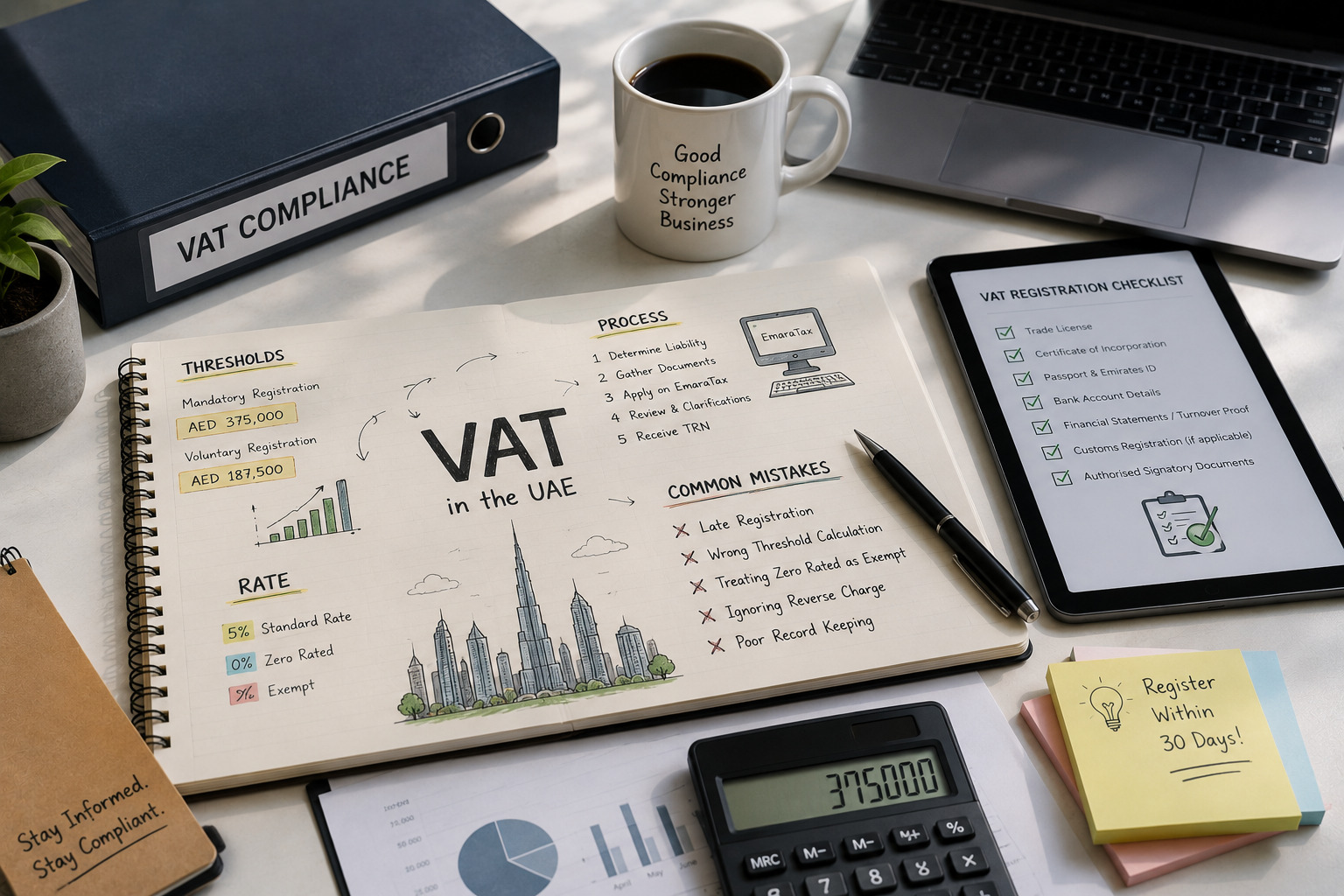
VAT Registration in the UAE: Thresholds, Process & Common Mistakes
Quick Read
- VAT has applied in the UAE since 1 January 2018 at a standard rate of 5%.
- Mandatory registration threshold: AED 375,000 in taxable supplies and imports over the previous 12 months, or expected to be exceeded within the next 30 days.
- Voluntary registration threshold: AED 187,500 in taxable supplies, imports, or taxable expenses.
- Registration is completed through the Federal Tax Authority's EmaraTax portal.
- A business must apply within 30 days of becoming liable to register.
- Non-resident businesses making taxable supplies in the UAE have no threshold — registration is required regardless of turnover where no other person is obliged to account for the tax.
- Tax Registration Numbers (TRNs) must appear on every tax invoice issued.
- The most common failures are late registration, threshold miscalculation, and treating zero-rated supplies as exempt.
What VAT Registration Actually Means
Value Added Tax is an indirect tax charged at each stage of the supply chain and ultimately borne by the end consumer. Businesses registered for VAT act as collection agents for the Federal Tax Authority — they charge output tax on their supplies, recover input tax on their purchases, and remit the difference.
Registration is not a formality. It creates a legal obligation to issue compliant tax invoices, maintain records for a prescribed retention period, file returns on a fixed cycle, and account for tax on both supplies made and, in defined circumstances, supplies received.
The governing framework is Federal Decree-Law No. 8 of 2017 on Value Added Tax, as amended by Federal Decree-Law No. 18 of 2022, together with Cabinet Decision No. 52 of 2017 (the Executive Regulation) and its subsequent amendments.
Who Must Register: The Thresholds
Mandatory Registration
A business established in the UAE must register for VAT where either of the following applies:
Retrospective test. The total value of taxable supplies and imports over the previous 12-month period exceeded AED 375,000.
Prospective test. The business anticipates that the total value of taxable supplies and imports will exceed AED 375,000 within the coming 30 days.
The retrospective test is a rolling calculation, not a financial-year calculation. A business must assess its position on an ongoing basis rather than waiting for year-end accounts.
Voluntary Registration
A business may apply to register where the value of taxable supplies, imports, or taxable expenses exceeded AED 187,500 in the previous 12 months, or is expected to exceed that figure in the next 30 days.
The inclusion of taxable expenses is significant and widely misunderstood. A pre-revenue business with substantial input costs — a startup building infrastructure, for example — may qualify for voluntary registration on expenditure alone, allowing it to recover input tax before it begins generating revenue.
Non-Resident Businesses
Where a person has no place of residence in the UAE but makes taxable supplies in the State, and no other person is obliged to account for the tax due on those supplies, that person must register regardless of value. There is no registration threshold for non-residents in these circumstances.
What Counts Toward the Threshold
The threshold calculation includes:
- Standard-rated supplies (5%)
- Zero-rated supplies (0%)
- Imported goods and services that fall within the reverse charge mechanism
- The value of any relevant goods and services supplied to the business where the business is required to account for the tax
The threshold calculation excludes:
- Exempt supplies
- Supplies made by a business that has ceased trading
- The sale of capital assets
- Supplies falling outside the scope of UAE VAT
This distinction is where a large proportion of registration errors originate. Zero-rated supplies carry a 0% rate but remain taxable supplies — they count toward the threshold in full. Exempt supplies do not.
Zero-rated categories include exports of goods and services outside the GCC implementing states, international transport, certain investment-grade precious metals, the first supply of newly constructed residential property within the prescribed period, and defined education and healthcare services.
Exempt categories include specified financial services, the supply of bare land, local passenger transport, and the lease or sale of residential property other than the first supply.
A business that classifies its exports as exempt rather than zero-rated will systematically understate its threshold position — and may be unregistered for years while legally liable.
The Registration Process
Step One: Determine Liability and Date
Establish the precise date on which the threshold was crossed, or on which it is anticipated to be crossed. This date determines the deadline for submission and the effective date of registration.
Step Two: Assemble Documentation
The Federal Tax Authority requires supporting evidence at application. Typical requirements include:
- Trade licence
- Certificate of incorporation, where applicable
- Articles of association, partnership agreement, or equivalent constitutional document
- Passport and Emirates ID of the owner, partners, or authorised signatory
- Proof of authorisation for the signatory
- Contact details and physical address of the business
- Bank account details, including IBAN, in the name of the legal entity
- Customs registration details, where the business imports or exports
- Financial records evidencing turnover — audited accounts, bank statements, or signed revenue declarations
Documentation requirements vary by entity type and activity. Free zone entities, branches of foreign companies, and businesses applying for tax group registration face additional requirements.
Step Three: Create an EmaraTax Account
Registration is submitted exclusively through EmaraTax, the Federal Tax Authority's digital platform. Where a business already holds a Corporate Tax registration, the same EmaraTax profile is used — a separate account is not created.
Step Four: Complete and Submit the Application
The application captures entity details, business activities, projected and historical turnover, bank details, and, where relevant, details of any customs registration or intended tax group.
Accuracy at this stage matters disproportionately. Inconsistencies between declared turnover and supporting financial records are the most frequent cause of rejection or clarification requests.
Step Five: Respond to Clarification Requests
The Federal Tax Authority may issue a request for additional information. These requests carry a response deadline; failure to respond within the stated period results in rejection and requires a fresh application.
Step Six: Receive the Tax Registration Number
On approval, the Federal Tax Authority issues a Tax Registration Number and a VAT registration certificate confirming the effective date of registration and the assigned tax period.
From the effective date, the business must charge VAT on its taxable supplies, issue compliant tax invoices displaying the TRN, and file returns on the assigned cycle.
Tax Groups
Two or more legal persons may apply to register as a single taxable person — a tax group — where each has a place of establishment or fixed establishment in the UAE, the persons are related parties, and one or more controls the others.
The group receives a single TRN, files a single return, and supplies between group members fall outside the scope of VAT. Members are jointly and severally liable for the group's tax obligations.
Tax grouping is not automatically advantageous. Where one member makes predominantly exempt supplies, grouping can restrict input tax recovery across the entire group.
Common Mistakes
Applying Late
The obligation is to submit within 30 days of becoming liable. Businesses frequently monitor turnover annually rather than on a rolling 12-month basis and discover the breach months after it occurred. Late registration carries an administrative penalty and, more materially, retrospective liability — the business must account for output tax on supplies made from the effective date, whether or not it charged VAT to its customers.
Confusing Zero-Rated with Exempt
Discussed above, and worth repeating: zero-rated supplies count toward the threshold; exempt supplies do not. Exporters in particular are exposed to this error.
Excluding Reverse-Charge Imports
Imported services are frequently omitted from threshold calculations. Where a business receives services from a foreign supplier and is required to account for the tax under the reverse charge mechanism, the value of those services forms part of the threshold calculation.
Applying the Financial-Year Test
The retrospective test is a rolling 12-month calculation. A business whose turnover is seasonal may cross the threshold mid-year and fallback below it by year-end — the obligation crystallised at the moment of crossing.
Registering Under the Wrong Legal Entity
Registration must be in the name of the legal person making the supplies. Businesses operating multiple trade licences under one entity register once; businesses operating separate legal entities register separately, or apply for tax group registration where the conditions are met.
Treating Voluntary Registration as Reversible on Demand
Voluntary registration carries the same compliance obligations as mandatory registration, and deregistration is subject to conditions and a minimum period. A business that registers voluntarily to recover input tax on setup costs commits to the full compliance cycle.
Neglecting Deregistration
A registrant must apply to deregister where it ceases making taxable supplies, or where taxable supplies over the previous 12 months fall below the voluntary registration threshold. Deregistration applications carry their own submission deadline and their own penalty for lateness.
Non-Compliant Tax Invoices
A tax invoice must contain prescribed particulars, including the words "Tax Invoice", the supplier's name, address and TRN, the date of issue, a description of the goods or services, the tax rate and amount, and the total amount payable. Non-compliant invoices expose the recipient's input tax recovery to challenge.
Poor Record Retention
Records must be retained for the period prescribed under the Tax Procedures Law, with an extended period applying to real estate records. Businesses that discard supporting documentation after filing lose the ability to defend positions on audit.
Free Zone Considerations
The existence of a business in a free zone does not, in itself, alter VAT registration obligations. Free zone entities making taxable supplies in the UAE are subject to the same thresholds and the same 30-day submission window.
A limited category of free zones has been designated by Cabinet Decision as Designated Zones for VAT purposes. Supplies of goods between Designated Zones, and certain supplies within them, may be treated as outside the scope of UAE VAT subject to strict conditions relating to fencing, customs controls, and internal procedures. The treatment applies to goods, not services — services supplied within a Designated Zone are generally treated as supplied within the UAE.
Designated Zone status is conferred by Cabinet Decision and is subject to amendment. Businesses should verify the current status of their zone rather than relying on historical lists.
Interaction with Corporate Tax
VAT registration and Corporate Tax registration are separate obligations with separate thresholds, separate deadlines, and separate returns. A business registered for VAT is not automatically registered for Corporate Tax, and the reverse is equally true.
Both are administered through EmaraTax under a single account. The convenience of a shared portal has produced a persistent misconception that one registration satisfies both. It does not.
Frequently Asked Questions
What is the VAT registration threshold in the UAE?
The mandatory registration threshold is AED 375,000 in taxable supplies and imports over the previous 12 months, or expected within the next 30 days. The voluntary registration threshold is AED 187,500 in taxable supplies, imports, or taxable expenses.
How long do I have to register for VAT after crossing the threshold?
An application must be submitted within 30 days of becoming liable to register.
What is the VAT rate in the UAE?
The standard rate is 5%. Certain supplies are zero-rated at 0%, and certain supplies are exempt.
Do zero-rated supplies count toward the registration threshold?
Yes. Zero-rated supplies are taxable supplies charged at 0% and are included in the threshold calculation in full. Exempt supplies are excluded.
Can I register for VAT voluntarily if my turnover is below the mandatory threshold?
Yes, provided taxable supplies, imports, or taxable expenses exceeded AED 187,500 in the previous 12 months, or are expected to exceed that figure in the next 30 days. Voluntary registration allows recovery of input tax but carries full compliance obligations.
Do free zone companies need to register for VAT?
Yes, where the mandatory threshold is met. Free zone status does not exempt a business from VAT registration. A limited number of zones hold Designated Zone status, which affects the treatment of goods, not the registration obligation itself.
Do non-resident businesses have a registration threshold?
No. A non-resident making taxable supplies in the UAE must register regardless of value where no other person is obliged to account for the tax on those supplies.
Where do I register for VAT?
Through EmaraTax, the Federal Tax Authority's online platform at tax.gov.ae.
Is a VAT registration the same as a Corporate Tax registration?
No. They are separate registrations with separate thresholds and separate returns, though both are administered through the same EmaraTax account.
Can related companies register together?
Yes, through tax group registration, where each entity has a place of establishment or fixed establishment in the UAE, the entities are related parties, and one or more controls the others. The group receives a single TRN and files a single return.
What happens if I register late?
Late registration attracts an administrative penalty and creates retrospective liability for output tax on supplies made from the effective date of registration, whether or not VAT was charged to customers at the time.
When must I deregister?
Where the business ceases making taxable supplies, or where taxable supplies over the previous 12 months fall below the voluntary registration threshold. Deregistration applications carry their own deadlines.
Does VAT apply to my export sales?
Exports of goods and services to destinations outside the GCC implementing states are generally zero-rated, subject to evidentiary conditions. They remain taxable supplies and count toward the registration threshold.
Before You Apply
Three checks resolve the majority of rejected applications:
- Recalculate the threshold on a rolling 12-month basis, including zero-rated supplies and reverse-charge imports, excluding exempt supplies and capital asset disposals.
- Reconcile declared turnover against financial records — bank statements, audited accounts, and revenue schedules must support the figure entered.
- Confirm the applicant is the correct legal person, and that bank details are held in that entity's name.
Where a business operates across multiple entities, holds free zone licences, or makes a mix of standard-rated, zero-rated and exempt supplies, the registration position warrants professional review before submission rather than remediation afterward.
About Consult Kumar®
Consult Kumar® is a Dubai-based business setup and corporate advisory consultancy operating under Team Squaree Businessmen Services LLC. The firm advises on company formation, tax registration and compliance, and ongoing corporate governance for businesses establishing and operating in the UAE.
This article is provided for general information and does not constitute tax advice. VAT thresholds, rates and procedural requirements are set out in Federal Decree-Law No. 8 of 2017 and its Executive Regulation, both of which are subject to amendment. Verify current requirements with the Federal Tax Authority at tax.gov.ae before acting.
